

When Yoga Loses Its Roots: Why Lineage and Living Tradition Still Matter
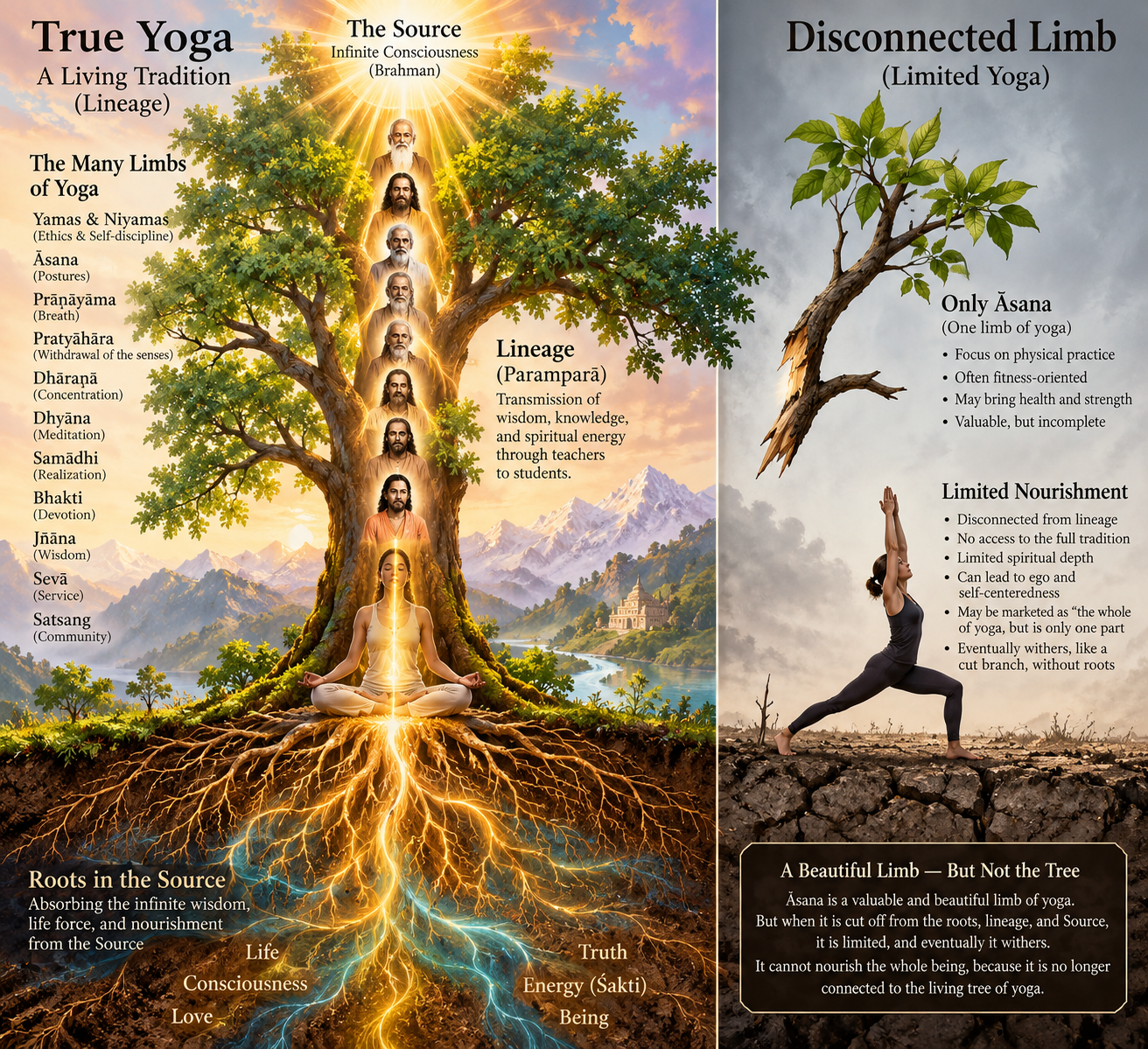
“Yoga lineage illustrated as a living tree, connecting students and teachers through generations to the spiritual source of yoga.”
When Yoga Loses Its Roots: Why Lineage and Living Tradition Still Matter —
Yoga entered my life when I was very young, and it has remained part of my life ever since. I have practiced for most of my life and taught for many years. Yet recently, I found myself searching for something that I once assumed would always be part of yoga: a living yoga community.
There is certainly no shortage of yoga today. There are studios everywhere. There are classes, workshops, retreats, teacher trainings, online programs, and countless styles of physical practice. In many ways, yoga has never been more accessible.
And yet, as I searched, I found myself asking a surprisingly difficult question:
Where is the yoga?
I don't mean that as a criticism of the people teaching or practicing today. And I certainly don't mean that asana—the physical practice of yoga—is somehow unimportant or less authentic. Asana is a beautiful and valuable part of yoga. It can strengthen and heal the body, cultivate discipline and awareness, quiet the mind, and sometimes open a doorway into something much deeper.
But asana was never the entire tree.
The Tree and Its Roots
I often think of yoga as a great living tree.
Its many branches are the different expressions and paths of yoga. Asana is one of those branches—and it is a magnificent one.
But underneath the tree is an enormous system of roots.
Those roots are not always visible.
They are the teachings, practices, wisdom, experiences, and realizations passed from teacher to student across generations. In Sanskrit, this transmission is often described as parampara: an unbroken stream through which knowledge is received, practiced, understood, and passed onward.
And beneath even those roots lies something deeper still.
The Source.
Whatever language we use for it—Brahman, Infinite Consciousness, God, Truth, Being—the great yoga traditions ultimately point beyond the personality of any individual teacher toward something greater.
A teacher receives from a teacher.
That teacher received from another.
Follow the lineage backward far enough, and eventually the personalities begin to disappear.
What remains is the Source.
This is why lineage matters.
Not because the past should be worshipped simply because it is old, and not because teachers should be followed blindly. A living tradition must breathe. It must encounter new cultures, new knowledge, new questions, and new generations.
But a living tree can grow new branches because it remains connected to its roots.
And perhaps that is what I have been missing.
Perhaps what I have been looking for is not another yoga class at all.
I am looking for sangha.
What Do I Mean by Sangha?
When I say that I am looking for sangha, I don't simply mean that I want to be surrounded by other people who practice yoga.
Community alone is not necessarily sangha.
For me, sangha is a community gathered around a shared spiritual intention. It is a place where we can practice together, learn together, question together, and sometimes simply sit together in silence.
It is a place where asana may be practiced, but where yoga does not end when we roll up our mats.
I am looking for a community where meditation has a place. Where pranayama has a place. Where philosophy and the ancient teachings of yoga are not treated as interesting historical footnotes, but as living wisdom that we can continue to explore.
A community where mantra and chanting are not considered strange or embarrassing. Where devotion can exist alongside intellectual inquiry. Where questions about God, consciousness, the Self, suffering, compassion, service, and liberation are welcomed rather than avoided because they might seem too spiritual.
I am looking for a place where teachers remember their teachers.
Not because those teachers were perfect human beings. They weren't. And lineage should never require us to surrender our discernment or excuse harmful behavior simply because someone carries the title of guru or teacher.
Quite the opposite.
A genuine spiritual tradition should encourage us to become more discerning, more conscious, more compassionate, and more capable of seeing clearly.
For me, lineage is not about worshipping personalities.
It is about remembering that the teachings did not begin with us.
Someone taught us.
Someone taught them.
And someone taught the person before them.
That chain stretches backward through generations—across countries, languages, cultures, and centuries.
When I teach yoga, I am therefore not standing alone at the front of a room saying, Here are my ideas about yoga.
Behind me stand my teachers.
And behind them, their teachers.
And behind them, still others.
This does not diminish the individual teacher. I think it does something much more beautiful:
It reminds us that we belong to something larger than ourselves.
The Yoga I Remember
Perhaps I feel the absence of this so strongly because the yoga I encountered when I was young was steeped in this understanding.
Yoga wasn't something I experienced only during an hour-long class.
There were teachers and teachings. There was meditation. There was chanting and philosophy. There was seva—selfless service. There were questions about the mind, the ego, consciousness, suffering, God, and the nature of the Self.
There was also laughter, friendship, disagreement, work, ordinary life, and community.
It wasn't perfect.
No spiritual community made up of human beings ever is.
But there was a sense that all of these things belonged together.
Yoga was not simply something we did. It was something we were trying to understand—and ultimately, something we were trying to live.
And perhaps that is why, when I look around today and see yoga flourishing everywhere, I can simultaneously feel grateful for how widely it has spread and saddened by something that seems to be disappearing.
The branches have grown enormously.
But sometimes I find myself searching for the roots. 🌳
About the Author
Tone Jackson is the founder of Healthwork Yoga & Massage Therapy in Albuquerque, New Mexico. A Certified Yoga Teacher since 1991 and Licensed Massage Therapist since 1998, she has practiced yoga from a young age and received her yoga teacher training through the Sivananda tradition. Her approach to yoga is rooted in the understanding that yoga extends beyond physical practice to include meditation, philosophy, self-inquiry, service, and spiritual connection.